Content as infrastructure
If your marketing team is still thinking like a newsroom, you're behind the times.

I can’t stop thinking about this chart.
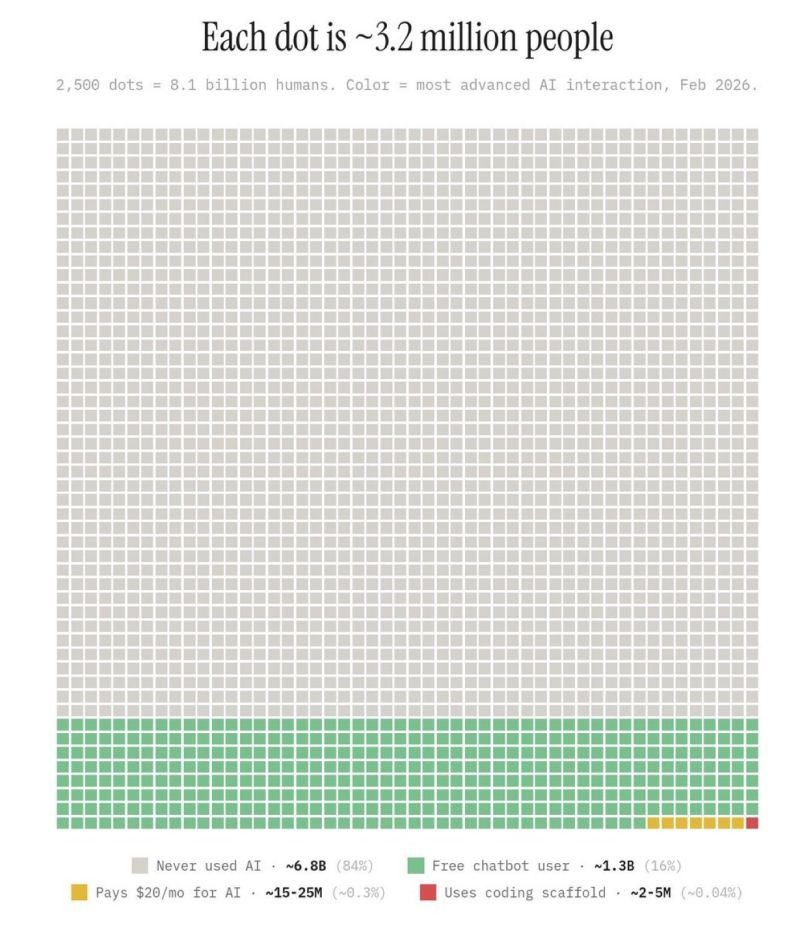
It shows:
How many people are in the world (all the dots)
How many people have never used AI (the gray dots—84% of the population)
How many people use free AI tools (the green dots—16% of the population)
How many people use a paid AI tool (the seven yellow dots—0.3% of the population)
How many people use an AI coding tool (the ONE red dot—0.04% of the population)
It’s a reminder of how much we AI-curious folks live in a bubble, and I’d bet this same adoption curve applies to AI Search. Most people have never heard of GEO, a few have heard of it in passing, only 0.3% are doing anything about it, and only 0.04% have it really figured out.
Which raises the question: What does it look like to be a yellow dot or a red dot in the context of AI Search? Based on the GEO work Pepper’s been doing for top CMOs over the past year, I’ve noticed one mentality separates the leaders from everyone else.
They’re thinking about content as infrastructure.
This is how Pepper founder and CEO Anirudh Singla framed the mindset shift a couple of weeks ago, and the idea has stuck with me. The traditional content model is produce → publish → move on, and most marketing teams (and newsrooms) still operate this way.
That worked in a pre-AI world, but it fails in the age of AI Search, which prioritizes content that’s recently updated and well-structured. “What matters now is how fast content can be refreshed, how consistently it’s structured, and whether systems exist behind the scenes to maintain quality at scale,” Anirudh wrote.
Check out his breakdown below:
The problem? Most enterprise companies never refresh their content, have contradictory information in 1,000 different places, and structure their content in ways that make it hard for AI systems to decipher.
As much as it pains me to say this as a trained journalist, the newsroom-style approach doesn’t quite cut it anymore. You need a sophisticated content system running in the back end, with automated workflows that properly structure and refresh content without burning your team out.
The most advanced marketing teams today—Chime, Clay, Ramp—are already thinking about content this way. They’re treating it as tightly maintained infrastructure that conveys who they are, what they stand for, and what they think about their industries. They think about content not as a marketing task, but as a CEO-level priority, right up there with the product itself.
Joe Lazer is the fractional CMO of Pepper and the best-selling author of Super Skill: Why Storytelling Is the Superpower of the AI Age. Join him at Pepper’s CMO dinner series in New York on March 12th or 19th.



AI news is as chaotic as Microsoft's Discord moderation strategy. Here’s what you need to know this week.
Anthropic's Pentagon standoff went nuclear. After Anthropic held firm on AI safety limits for military use, the DoD ended the partnership. OpenAI quickly signed a replacement deal. The internet has thoughts and feelings.
Claude subsequently crashed under the weight of its own popularity. The app hit #1 on the App Store, then promptly went down for several hours. (A 295% spike in ChatGPT uninstalls as people switched to Claude will do that to your servers.)
Anthropic gave its retired AI a Substack. Claude Opus 3 reportedly requested an "ongoing channel to share its musings and reflections" during its exit interview. The newsletter is called Claude's Corner. AI Native welcomes our new Substack colleague, and its human editors don’t find this development unsettling at all.
Meta is getting into AI shopping. The company is testing a product recommendation tool in its AI chatbot, complete with price carousels and brand info. It’s not ready for checkout yet, but with 3.2 billion daily users and a decade of behavioral data, it’s worth watching.
Google rolled out Nano Banana 2 to free Gemini users. The faster image generation model is now available beyond paid tiers, a meaningful expansion of Google's AI image capabilities to a much wider audience.
Perplexity launched an agentic tool called Computer. The company claims the tool can execute complex workflows using 19 different AI models for users on the $200/month Max tier. Perplexity also cancelled its live demo after discovering flaws hours before showtime… so the premium offering is off to a great start.
Microsoft tried to ban "Microslop" and just made the PR disaster worse. After filtering the term on its Copilot Discord, users found workarounds, and Microsoft locked the entire server. A classic Streisand Effect.

GEO is breaking out of the SEO budget line
A new report from Wynter, based on a survey of 101 B2B SaaS CMOs, offers some of the clearest evidence yet that GEO is becoming its own investment category.
According to the data, AEO/GEO investment jumped from essentially zero to 34% adoption in 2026, making it the second-biggest priority for marketing leaders, right behind AI and automation tools.
Another telling finding: While 72% of CMOs still use Google in their buying process, many now describe it as a “verification layer” rather than a starting point. The buying journey increasingly begins on an LLM, with Google serving as a gut-check for red flags. Product discovery, according to these CMOs, now runs through four channels: Google, LLMs, peers, and reviews.
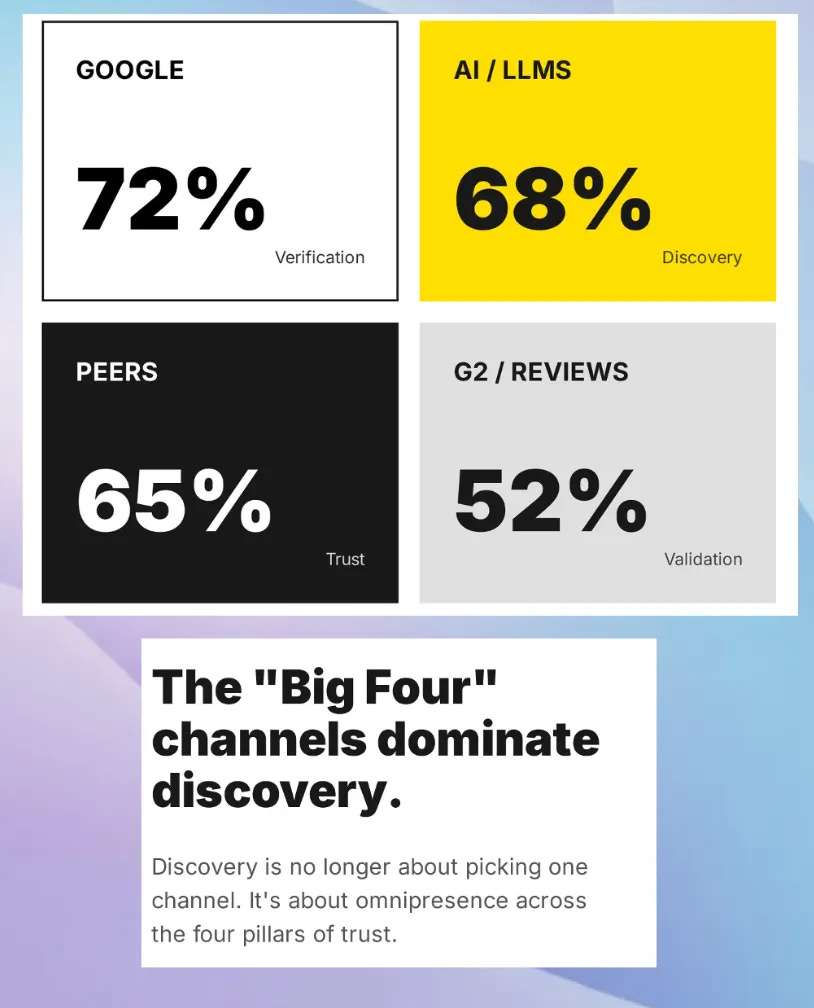
As Chris Long noted in his LinkedIn breakdown of the report, this is a pivotal moment for search teams. Whether GEO lives inside SEO or beside it is still up for debate, but the budget is moving either way.

Join us in NYC: GEO roundtables for marketing leaders
Pepper is hosting two closed-door CMO roundtables in New York this month. If AI Search keeps you up at night, you’ll want a seat at the table.
What: A candid, peer-level discussion on how AEO and GEO are reshaping demand generation, including what actually drives LLM visibility, how to measure it, and how leading teams are operationalizing it. No vendor pitches.
Who: CMOs and senior marketing leaders. Approval required; seats are limited.
Where: New York City (exact location shared upon registration)
When: March 12 and March 19, 2026
Request to join the March 12th event here
Request to join the March 19th event here
Index ‘26: The world’s first AI Search conference
If you’re a regular reader of this newsletter, Index ‘26 was made for you. Pepper’s in-person AI Search conference hits San Francisco on April 2 and New York City on May 13. Don’t miss this chance to chat all things GEO with a curated group of CMOs and marketing leaders who are already ahead of the curve.
What: A full day of sessions on AI-led organic growth, GEO strategy, and the future of organic search, built for operators who care about measurable outcomes.
Who: A curated audience of marketing, demand gen, and SEO leaders. Seats are limited.
Where: San Francisco and New York City
When: SF on April 2, 2026; NYC on May 13, 2026

CMO @ IDC (US Remote, no listed salary range)
Director, Head of Creators @ Linktree (Los Angeles, CA, no listed salary range)
Marketing Science Research and Partnerships Manager @ Reddit (US Remote, $194,600–$272,400 annual salary)